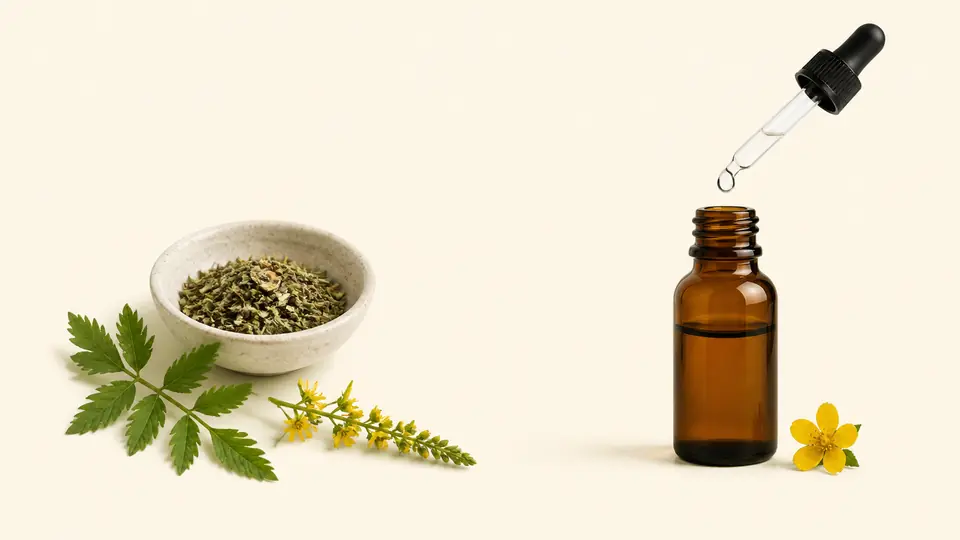
The agrimony herb vs Bach flower remedy question often begins with two bottles that show the same plant name but contain different preparations. Ordinary agrimony products use dried herb, powder, or a direct botanical extract. Bach Agrimony is a highly diluted flower essence. HerbEra uses one practical distinction: identify the manufacturing method before assuming that products with the same plant source are equivalent.
Both may refer to Agrimonia eupatoria, or common agrimony. That shared species does not make their contents, concentration, labeling, or evidence interchangeable.
Is Bach Agrimony an Ordinary Herbal Extract?
No. A Bach Agrimony remedy is not a conventional agrimony tincture or concentrated herbal extract.
An agrimony herbal product starts with a stated amount of plant material. It may contain cut flowering tops, powdered aerial parts, or an extract made directly with water, alcohol, or another permitted solvent. The label may declare milligrams, an extract ratio, or the starting herb represented by each serving.
A Bach preparation follows a different system. Traditional instructions place Agrimony in the sunshine method, which exposes flowers to water before removing the plant material, adding brandy, and diluting the preparation further. Some retail labels use homeopathic notation instead of milligrams of herb.
| Comparison point | Agrimony herb product | Bach Agrimony remedy |
|---|---|---|
| Typical plant source | Agrimonia eupatoria flowering tops or aerial parts | Agrimonia eupatoria flowers used in the Bach preparation system |
| Product type | Tea, loose herb, powder, capsule, tincture, or botanical extract | Diluted flower essence in a dropper bottle |
| Manufacturing approach | Direct use or extraction of measurable plant material | Flower-water preparation followed by preservation and dilution |
| Concentration language | Milligrams, herb-to-extract ratio, serving amount, or standardization | Drops, stock bottle language, or dilution notation such as 5X |
| Common liquid base | Water, ethanol, glycerin, or a combination, depending on the extract | Water and brandy or alcohol, with glycerin versions also available |
| Plant part on label | Should identify flowering tops, aerial parts, leaf, or another actual part | May identify the botanical source but often emphasizes remedy name and dilution |
| Direct substitute | No | No |
How Is Each Product Made?
The production method explains most of the difference. It also tells you why equal drop counts do not represent equal botanical amounts.
Conventional Agrimony Preparation
European herbal documentation defines agrimony as material from Agrimonia eupatoria, with dried flowering tops used in pharmacopoeial material. A tea places cut herb in water. A conventional tincture keeps the herb in a water-alcohol mixture so soluble plant constituents move into the liquid. A dry extract removes much of the solvent and concentrates the resulting extract before it enters a capsule or tablet.
The composition depends on the plant part, starting quantity, solvent, extraction ratio, temperature, and processing.
Bach Flower Preparation
The wider Bach system uses sunshine and boiling methods. Agrimony appears in the sunshine group. Fresh blooms float in spring water under direct sunlight for about three hours. The flowers are removed, and the prepared water is mixed with an equal volume of brandy to create what the system calls a mother tincture.
The Bach Centre describes further dilution at two drops of mother tincture per 30 mL of brandy to make a retail stock bottle. “Mother tincture” does not have one meaning across every production system.
What Do 5X, HPUS, and Alcohol Percentage Mean?
These terms identify a homeopathic-style label, not a standard herbal extract specification.
A United States DailyMed listing for one Bach Original Agrimony product declares a 5X dilution of Agrimonia eupatoria under HPUS and 27 percent alcohol as an inactive ingredient. It categorizes the product as an unapproved homeopathic drug. This example does not describe every flower essence worldwide.
The letter X indicates decimal dilution notation. It does not mean 5 mg, 5 percent herb, or a 5:1 botanical extract. HPUS refers to the Homeopathic Pharmacopoeia of the United States. An alcohol percentage describes the liquid vehicle, not the concentration of agrimony plant compounds.
Alcohol-free remedies may use vegetable glycerin, while conventional tinctures can also contain alcohol. Identify the product through its statement of identity, dilution notation, plant amount, and manufacturing description.
HerbEra’s editorial standard is to follow the declared composition: when a label gives a dilution potency instead of herb weight or an extract ratio, it should not be presented as a conventional agrimony tincture.
How Can You Identify the Product from the Label?
Start with the panel heading and statement of identity. A dietary supplement in the United States normally uses a Supplement Facts panel. A homeopathic product often uses the word “homeopathic,” lists an active ingredient in Latin, and shows dilution notation such as X or C.
| Label clue | Likely meaning | What to verify |
|---|---|---|
| Flowering tops, 500 mg | Measured agrimony herbal material | Species, plant part, and serving size |
| Herbal extract, 1:5 | Conventional extraction ratio | Solvent and whether the ratio describes starting herb |
| 5X HPUS | Homeopathic dilution notation | Statement of identity and regulatory category |
| Stock remedy | Flower essence terminology | Preservative, dilution, and bottle directions |
| 27 percent alcohol | Alcohol content of the liquid vehicle | Whether alcohol fits the buyer’s requirements |
| Agrimony with no species | Incomplete botanical identification | Confirm Agrimonia eupatoria and the product type |
For a conventional botanical supplement, the plant part is a key identity detail. FDA guidance states that a botanical dietary ingredient’s plant part belongs in the Supplement Facts panel. Regulatory rules differ across countries, and some agrimony teas may be sold as foods rather than supplements.
For a homeopathic label in the United States, do not interpret market availability as FDA approval. FDA states that no homeopathic product is FDA-approved and that these products have not undergone its premarket review for safety and effectiveness.
Can Evidence for Agrimony Herb Be Applied to Bach Agrimony?
No. Research must match the preparation being discussed.
Studies of agrimony tea, powder, or direct extracts examine conventionally prepared botanical material. Their findings do not automatically apply to a diluted flower essence. Likewise, a Bach remedy study cannot establish the composition or performance of an agrimony herbal extract.
The European Medicines Agency’s agrimony monograph concerns A. eupatoria herb and traditional herbal preparations. It should not be cited as evidence for a Bach flower product. A traditional-use monograph also does not equal modern proof for every retail tea, tincture, or capsule.
Clinical research on Bach flower remedies remains limited. A 2010 systematic review located seven randomized trials. Six used placebo controls, and none of those placebo-controlled trials found a difference between flower remedies and placebo. An earlier systematic review assessed four controlled trials and rated the available evidence as low or very low. These reviews examined the broader Bach system, not the chemical equivalence of Agrimony flower essence and agrimony herb.
The practical conclusion is about product identity, not personal experience: the same plant name cannot bridge two different manufacturing systems or evidence bases.
Agrimony Product Buying Checklist
Use this checklist before purchasing agrimony drops, tea, capsules, or loose herb. It focuses on what the product contains and how it was made. Complete each step without relying on the front product name alone.
Read the Statement of Identity
Determine whether the item is a food, dietary supplement, herbal preparation, flower essence, or homeopathic product.
Confirm the Species
Look for Agrimonia eupatoria. Ask the seller if the label gives only the common name agrimony.
Find the Plant Part
For an herbal product, identify flowering tops, aerial parts, leaf, or another declared part.
Check the Amount Format
Separate milligrams and extract ratios from dilution notation such as X or C. They describe different preparation systems.
Review the Liquid Base
Check the alcohol percentage, glycerin, water, and other ingredients. Do not assume every dropper product has the same base.
Match the Evidence
Use research only when its species, product type, and preparation match the item under review.
Reject Automatic Substitution
Do not substitute a flower remedy for agrimony tea or tincture, or use the herbal product in its place, based only on the shared plant name.
FAQ
Is Bach Agrimony the Same as Agrimony Tincture?
No. Bach Agrimony is a diluted flower essence, while an agrimony tincture directly extracts plant material into a liquid solvent.
Do Both Products Use Agrimonia eupatoria?
They may. The same botanical source does not make the finished products equivalent.
Does 5X Mean the Product Contains 5 Percent Agrimony?
No. 5X is homeopathic decimal dilution notation. It is not a percentage or milligram declaration.
Does a Bach Agrimony Bottle Contain Alcohol?
Many stock bottles use alcohol as a preservative, but glycerin-based versions also exist. Check the specific ingredient panel.
Can Bach Agrimony Replace Agrimony Tea?
No. They differ in preparation, concentration language, composition, and intended product category.
Is a Bach Flower Remedy a Dietary Supplement?
Not necessarily. Classification depends on the label and jurisdiction. Some United States products are labeled as homeopathic drugs.
Are Bach Flower Remedies FDA-Approved?
No. FDA states that no products labeled as homeopathic are FDA-approved.
Can Herbal Agrimony Research Support a Flower Remedy?
No. Evidence from a tea, powder, or direct extract should not be transferred to a highly diluted flower essence.
Glossary
Aerial parts
The portions harvested above ground, usually stems, leaves, and flowers.
Botanical extract
A preparation made by transferring soluble constituents from plant material into a solvent.
Extract ratio
The relationship between starting herb and the resulting extract under a stated convention.
Flower essence
A highly diluted preparation made through a flower-water process rather than direct conventional herb extraction.
HPUS
The Homeopathic Pharmacopoeia of the United States.
Mother tincture
An initial preparation used for later dilution, with meaning that varies between production systems.
Plant part
The specific botanical material used, such as flowering tops, leaf, root, or aerial parts.
Stock bottle
A retail flower remedy preparation made by diluting the mother preparation into a preservative base.
X potency
Decimal dilution notation used on homeopathic-style labels.
Conclusion
Agrimony herb and Bach Agrimony may start with the same species, but they are different products. Check the manufacturing method, amount format, plant part, dilution notation, and liquid base before buying.
Sources Used
- Agrimony botanical material and European herbal monograph, European Medicines Agency — ema.europa.eu/en/medicines/herbal/agrimoniae-herba
- Traditional Bach flower preparation methods and stock bottle dilution, The Bach Centre — bachcentre.com/en/remedies
- United States label for Bach Original Agrimony 5X HPUS and 27 percent alcohol, DailyMed — dailymed.nlm.nih.gov/dailymed/fda/fdaDrugXsl.cfm
- Botanical ingredient and plant-part labeling guidance, U.S. Food and Drug Administration — fda.gov/food/dietary-supplements-guidance-documents-regulatory-information/dietary-supplement-labeling-guide-chapter-iv-nutrition-labeling
- Regulatory status and identification of homeopathic products, U.S. Food and Drug Administration — fda.gov/drugs/understanding-over-counter-medicines/homeopathic-products
- Systematic review of randomized Bach flower remedy trials, PubMed — pubmed.ncbi.nlm.nih.gov/20734279
- Systematic review of Bach flower remedies for psychological outcomes and pain, PubMed Central — pmc.ncbi.nlm.nih.gov/articles/PMC2695424